This article outlines the strategic integration between ProcessMaker’s Transcript Credit Evaluation (TCE) solution and Anthology’s comprehensive student information system (SIS). By leveraging the strengths of both platforms, educational institutions can significantly enhance the efficiency of transcript evaluation, reduce processing time, and improve the overall student experience.
Objectives
Automate Transcript Processing
Eliminate manual workflows by collecting and evaluating transcripts through automated processes integrated directly with Anthology's SIS.Improve Accuracy and Consistency of Credit Evaluations
Ensure that transfer credits are assessed using standardized criteria and business rules, minimizing subjective interpretations and inconsistencies.Enhance Reporting and Visibility for Academic Administrators
Provide real-time information for academic staff to monitor transcript workflows and credit decisions.Streamline Student Enrollment and Transfer Processes
Accelerate student onboarding by enabling faster evaluation and application of transfer credits, improving time to enrollment.
Integration Approach
This integration enables seamless data exchange between ProcessMaker and Anthology, allowing for automated collection, processing, and evaluation of transcripts. This helps institutions eliminate manual data entry, minimize human error, and accelerate decision-making for credit transfers and course placements.
Transcript data flows securely between systems via RESTful APIs and standardized formats such as JSON or XML. The architecture ensures reliable automation of the credit evaluation process, from initial submission to final database updates.
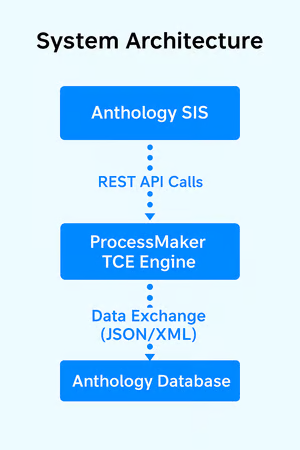
Workflow Overview
Data Ingestion: Transcripts submitted via the Anthology portal.
Data Transfer: Anthology transmits transcript data to ProcessMaker TCE through RESTful APIs.
Transcript Analysis: TCE evaluates credits against predefined rules and institution-specific guidelines.
Results Synchronization: Evaluated credits are returned to Anthology student records.
Reporting and Notification: Automated notifications are sent to students and administrators through Anthology.
Pseudocode Example
function evaluate_transcript(transcript_id):
    transcript_data = anthology_api.get_transcript(transcript_id)

    validated_data = validate_transcript(transcript_data)
    evaluation_results = []

    for course in validated_data.courses:
        evaluation = apply_credit_rules(course)
        evaluation_results.append(evaluation)

    update_status = anthology_api.update_evaluation(transcript_id, evaluation_results)

    if update_status.success:
        notify_student(transcript_id)
        notify_admin(transcript_id)

    return evaluation_results

function validate_transcript(transcript_data):
    // Ensure all mandatory fields and valid formats
    return sanitized_data

function apply_credit_rules(course):
    // Compare course data against institutional rules
    if course_matches_rules(course):
        return assign_credit(course)
    else:
        return no_credit_assigned(course)
Benefits of the Integration
Efficiency: Dramatically reduces manual processing effort.
Accuracy: Consistent and error-free credit evaluations.
Transparency: Real-time status updates for administrators and students.
Scalability: Capable of handling large volumes during peak enrollment periods.
For detailed implementation guidance, please contact the technical integration team.